Controversial Polish oil search stopped due to strike
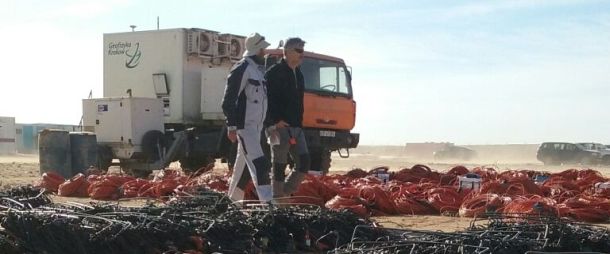
When over 100 of the locally recruited staff stopped working, the Polish oil hunt in occupied Western Sahara had to temporarily close.
Published 22 June 2016
An intense labour dispute has erupted between a subsidiary of the Polish oil company PGNiG and its locally recruited staff in occupied Western Sahara. According to the Saharawi media network Equipe Media, the Polish operations came to a complete stop from 4 June. Equipe Media covered the labour dispute twice, on 10 June and 14 June.
The Polish firm is undertaking onshore seismic studies in Western Sahara on a contract by the Moroccan state owned company, and under protection by the Moroccan army - a type of operation which the UN has found to be in violation of international law. See further coverage on the controversy here.
There are, according to Equipe Media, two large categories of locally recruited staff, with different grievances.
First, it is the ground clearance personel, consisting of 50 workers, of whom 30 are Moroccan, the remaining Saharawis. Before seismic trucks can do its work by shooting its sound waves into the ground, this team of staff need to manually remove all rocks along the route. Then team of 50 have to place large sand bags and install geophones along the route. According to Equipe Media, this team was initially supposed to tidy and cover 3-4 kilometers daily. However, at one point, the Polish company is said to have demanded that the survey speed be increased to 9 kilometers a day, under the same work conditions, staff size and salary as before. From 26 May, these 50 Saharawis and Moroccans went on strike. Their salary is said to be around 235 Euros a month, working for 12 hours a day, 7 days a week.
Second, 51 persons have been contracted on a 3 months contract by a local company, mainly for driving. Also these 51 are said to have been working 12 hours a day, seven days a week. However, they are said not to have proper contracts. So they laid down their work on 30 May.
According to Equipe Media, the company and the workers did not reach an agreement, and on 4 June, police and armed forces came to the compound and expelled all of them. The drivers of the larger trucks, all allegedly Moroccans, were lodged in OCP’s quarters in Boucraa.
12 locally recruited staff who were not part of the strike, of whom 10 were kitchen personell, were also kicked out.
When Equipe Media covered the issue last, on 14 June, the operations had been halted since 26 May.
No state in the world recognise the Moroccan sovereignty claims over the territory. The Polish company has failed to seek the consent from representatives of the people of Western Sahara prior to the start-up. Its contract is with the Moroccan state company.
News
Gdeim Izik prisoners resume hunger strike
Saharawi political prisoners have resumed a hunger strike in Moroccan prisons, demanding their release, improved detention conditions and the implementation of UN decisions.
06 October 2026
SRI update
The following overview enlists stock-exchange registered companies with current or recent operations in occupied Western Sahara. Updated 28 September 2026.
28 September 2026
Another company of the Moroccan king involved in occupied Western Sahara
A company closely linked to Morocco’s royal business network has entered a new project in occupied Western Sahara, partnering with a Chinese state-owned electricity giant on high-voltage infrastructure in Boujdour.
10 September 2026

Don't let resource exploitation decide Western Sahara's future
Western Sahara Resource Watch calls on the UN to address the accelerating exploitation of the territory’s natural resources - and prevent it from becoming an even greater obstacle to self-determination.
08 September 2026