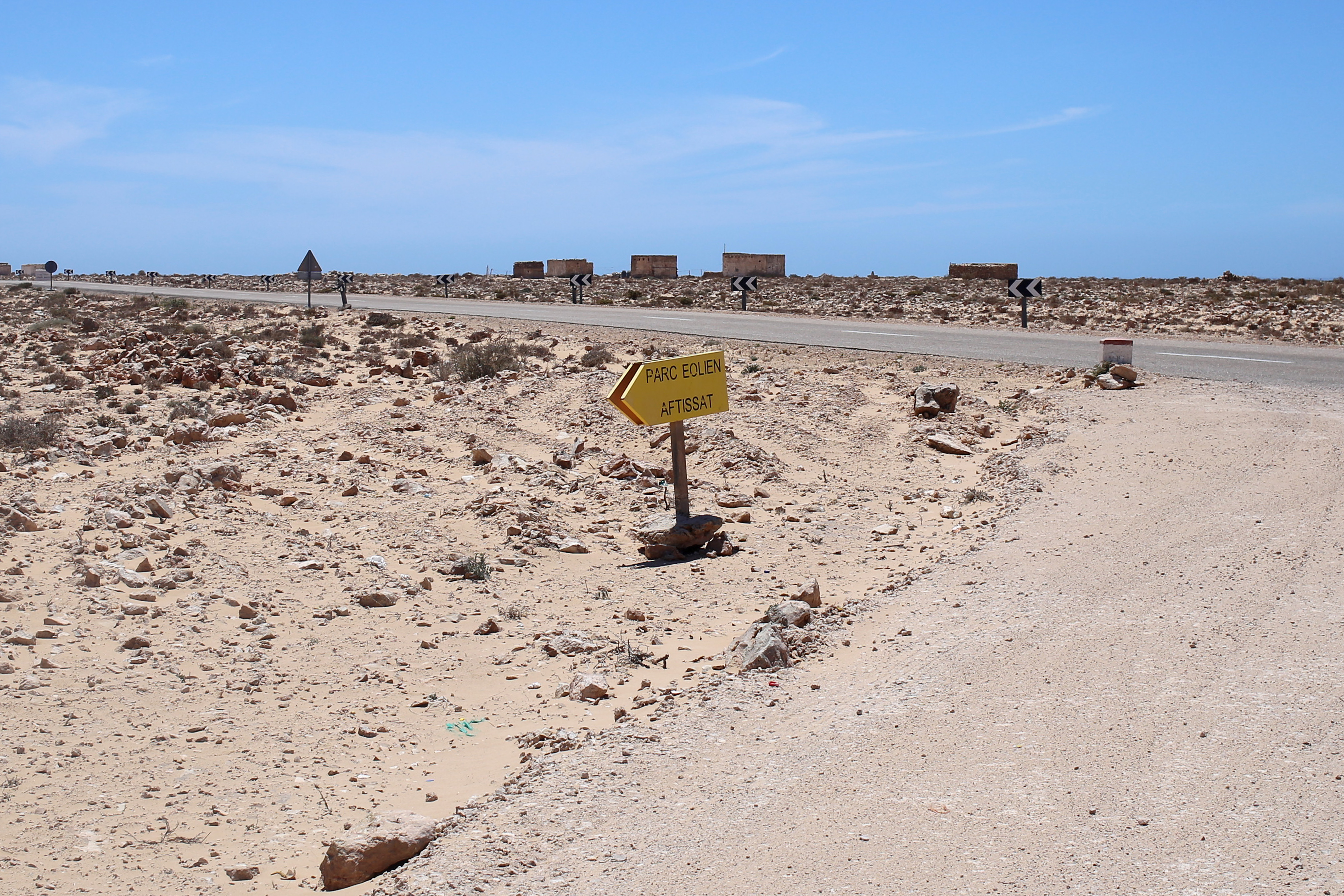
The Moroccan king’s energy company appears to have completed two new phases of the Aftissat wind power complex in occupied Western Sahara.
Nareva, the Moroccan energy company that is owned by the Moroccan monarchy’s holding company Al-Mada, has last week updated its website to include Aftissat 3 and Aftissat 4 as part of its operational portfolio.
Together with the already operating Aftissat 1 and 2 wind farms, the controversial complex now has a combined installed capacity of 550 MW, according to Nareva.
The company describes Aftissat as "a 550 MW wind complex, the second-largest in Africa", consisting of four phases with a combined annual electricity production of nearly 3,000 GWh. According to the updated project description, the complex comprises 121 turbines: 56 turbines of 3.6 MW in the first phase, 40 turbines of 5 MW in the second phase, and 25 turbines of 6.2 MW in the third and fourth phases.
The updated figures indicate that Aftissat 3 and 4 respectively add 100 MW and 50 MW of capacity to the existing 400 MW complex.
The website update follows several recent indications that construction had reached, or is close to reaching, completion. The Spanish-Portuguese logistics company Laso Lasarte Wind, responsible for transporting all wind turbines to the entire wind complex, recently announced the delivery of its final turbine components to the Aftissat wind farm.
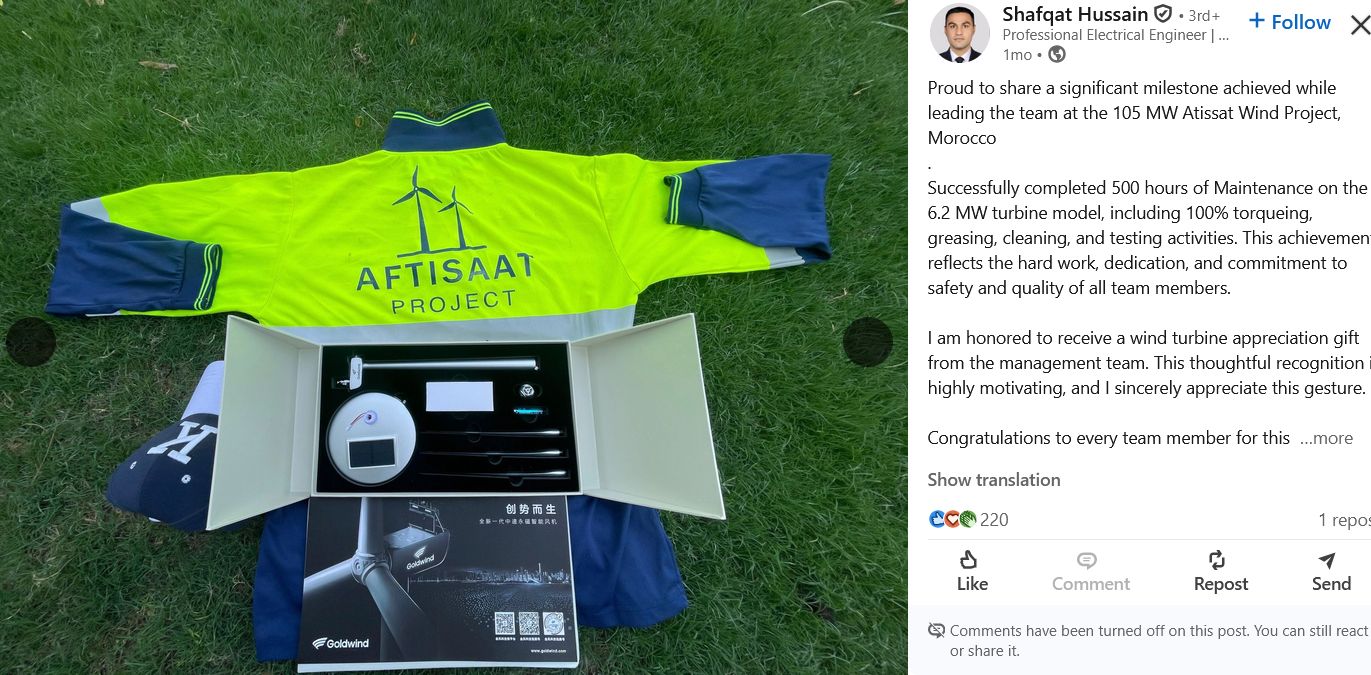
WSRW has written Goldwind over the matter. The company did not respond.
Once operational, the expanded Aftissat complex will become the second-largest wind power complex in Africa, behind the 650 MW Gulf of Suez Wind Farm II in Egypt.
Like the earlier phases, Aftissat 3 and 4 appear to have been developed under Morocco's legal framework No. 13-09, governing electricity generation for industrial consumers. Electricity generated under this regime is supplied directly to large industrial users through private power purchase agreements. Known offtakers of the already existing phases of the Aftissat complex OCP Group, Morocco’s state-owned phosphate company, and LafargeHolcim Maroc, a cement manufacturer.
Morocco’s wind power projects in Western Sahara are highly controversial because they are developed without the consent of the people of the territory. Their apparent purpose of supplying industrial users further reinforces concerns that the wind farms are designed to sustain Morocco's economic activities in the occupied territory.
Western Sahara is recognised by the United Nations as a Non-Self-Governing Territory whose people have not yet exercised their right to self-determination. Morocco has no recognised sovereignty over the territory, nor any international mandate to administer it. Its claims to the territory were rejected by the International Court of Justice. The Court of Justice of the European Union has repeatedly confirmed that Western Sahara is separate and distinct from Morocco under international law.
Western Sahara Resource Watch (WSRW) has long documented how Morocco's renewable energy programme in occupied Western Sahara underpins the occupation by supplying electricity to phosphate mining, desalination, military installations and other industrial activities established without the consent of the Saharawi people. The continued expansion of the Aftissat complex deepens that dependency while further integrating the occupied territory into Morocco's national electricity system.
“The project raises renewed questions for the companies involved in its construction and equipment supply. By participating in energy infrastructure developed in occupied Western Sahara without the consent of the Saharawi people, corporate actors risk contributing to the consolidation of an unlawful occupation”, Erik Hagen of WSRW said.
The apparent completion of Aftissat 3 and 4 fits into a broader expansion of Morocco's renewable energy programme in occupied Western Sahara. A publication by the Moroccan Federation for Energy identifies three additional wind farms planned for completion in 2027: Boujdour II (300 MW), Grad Jrad Laâyoune (120 MW) and Tiskrad (100 MW). The same publication had also projected Aftissat 3 and 4 for completion in 2026, a timeline that now appears consistent with Nareva's updated project portfolio. Boujdour II has not previously been reported by WSRW.
Since you're here....
WSRW’s work is being read and used more than ever. We work totally independently and to a large extent voluntarily. Our work takes time, dedication and diligence. But we do it because we believe it matters – and we hope you do too. We look for more monthly donors to support our work. If you'd like to contribute to our work – 3€, 5€, 8€ monthly… what you can spare – the future of WSRW would be much more secure. You can set up a monthly donation to WSRW quickly here.
Gdeim Izik prisoners resume hunger strike
Saharawi political prisoners have resumed a hunger strike in Moroccan prisons, demanding their release, improved detention conditions and the implementation of UN decisions.
SRI update
The following overview enlists stock-exchange registered companies with current or recent operations in occupied Western Sahara. Updated 28 September 2026.
Another company of the Moroccan king involved in occupied Western Sahara
A company closely linked to Morocco’s royal business network has entered a new project in occupied Western Sahara, partnering with a Chinese state-owned electricity giant on high-voltage infrastructure in Boujdour.
Don't let resource exploitation decide Western Sahara's future
Western Sahara Resource Watch calls on the UN to address the accelerating exploitation of the territory’s natural resources - and prevent it from becoming an even greater obstacle to self-determination.