The Irish company San Leon Energy has published a map on its webpages showing how they carried out oil search on occupied land.
Since San Leon Energy announced the termination of its “Moroccan” seismic programme 24 January, it has been unclear exactly where those studies were made. The operations were done by a 100% owned subsidiary, under a licence received from the Moroccan government.
A company presentation published on 28 January shows that the seismic study was shot in Western Sahara, a territory partially occupied by Morocco since 1975. The research programme is taking place in violation of the principles underlined by the UN in 2002: no further Moroccan oil search can take place in Western Sahara unless the people of the territory consent to it. They don’t.
Yet, San Leon holds two blocks on the border area between Morocco and Western Sahara. The section of the so-called Tarfaya licence which San Leon has been most interested in, is located in Morocco proper. The new company presentation confirms that the 2011 seismic on Tarfaya has most probably been shot in its pilot area in Southern Morocco.
The exact location of the Zag studies, however, is more controversial. The presentation shows how oil search was done on occupied land.

The map to the right shows parts of San Leon's licence in the south and Petrocanada/Suncor to the north. The neighbouring licences are separated by a horizontal white border. To the north, one can see the grids from the 2010 seismic program made by Petrocanada. To the south, one can observe a continuation of the grid system, extending all the way to the southern extension of the San Leon's Zag block.
It is probably not possible to do any more studies in the south-eastern direction of the block, since the licence is likely partially overlapping with the military separation wall that Morocco constructed on the occupied territory in the 1980s.
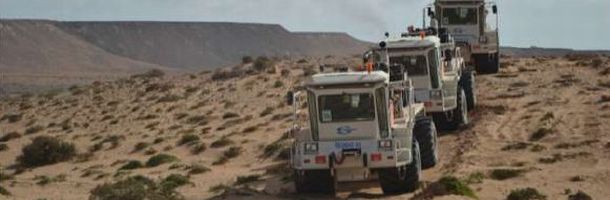
An image of the San Leon's trucks, owned by the subsidiary Novaseis, was also published (above). The image seems to have been shot in a landscape typical of the Zag block. Their studies on the block were delayed last summer due to the large presence of landmines in the area.

Heidelberg Materials deepens its role in Morocco’s occupation of Western Sahara
The German company confirms once again that its operations in occupied Western Sahara are closely tied to Morocco’s infrastructure expansion in the territory - while continuing to dismiss the Saharawi people’s right to consent.

The conflict phosphates - four decades of plunder
For over 40 years, a Moroccan state-owned company has exported phosphate rock from occupied Western Sahara.
Record low number of importers of Western Sahara phosphates
Only three companies imported phosphate rock from occupied Western Sahara in 2025 - the lowest number ever recorded. The findings appear in our annual P for Plunder report, released today.

One of the richest coastlines in the world
The fish stocks of occupied Western Sahara have not only attracted the interest of the Moroccan fleet: other foreign interests are also fishing in the occupied waters through arrangements with Moroccan counterparts. Along the Western Saharan coastline, a processing industry has emerged.