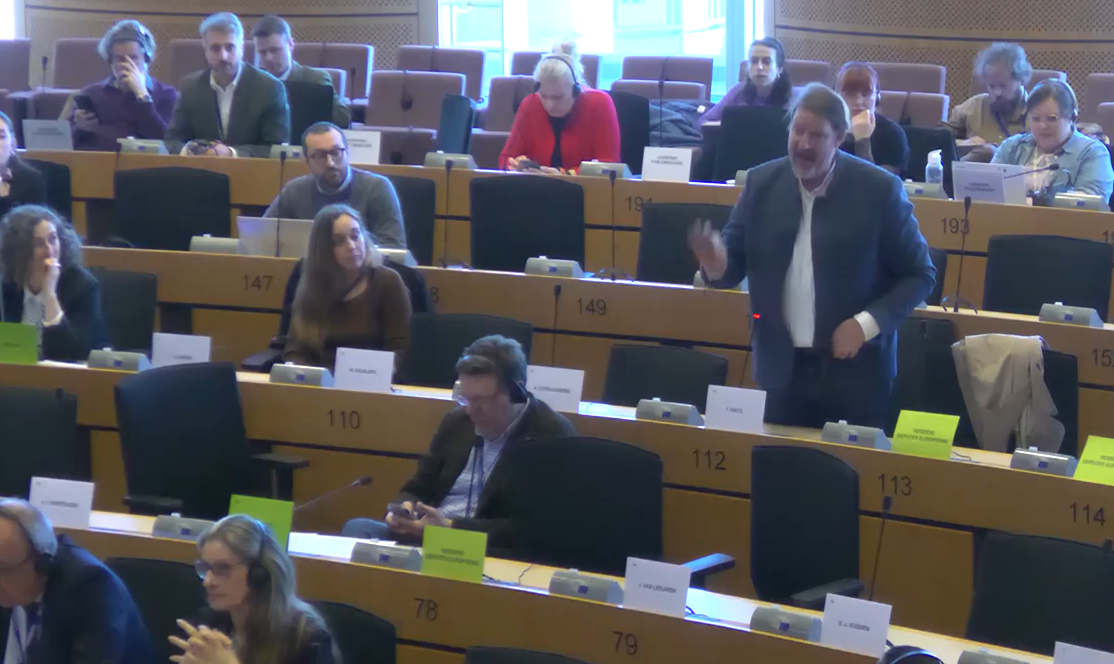
MEPs from across the political spectrum sharply criticised the European Commission over its handling of EU-Morocco trade relations covering occupied Western Sahara, raising concerns over legality, transparency and an apparent disregard for Parliament’s role.
Photo: MEP Thomas Waitz calling for a more direct “ping-pong” exchange, as the Commission failed to answer questions raised by MEPs. The room responds with applause.
The European Commission faced strong criticism from Members of the European Parliament (MEPs) during an exchange of views in the Parliament’s Agriculture Committee (AGRI) yesterday, 18 March 2025, as concerns mounted over the legality, transparency and substance of its approach to EU–Morocco trade relations covering Western Sahara.
The hearing took place in the context of the new trade arrangement covering products from Western Sahara under the EU–Morocco Association Agreement, provisionally applied since 4 October 2025. This runs counter to the EU Parliament’s stated opposition to provisional application, as it sidelines parliamentary scrutiny.
See the video of the hearing on the Parliament website here. A full transcript of the AGRI exchange can be accessed here.
Presenting on behalf of the Commission, Matthias Petschke (DG TAXUD) and Brigitte Misonne (DG AGRI) outlined the state of play. Their explanations, however, did little to ease tensions.
Petschke told the Members of the Agriculture Committee that the agreement is not agricultural in nature, as it covers all goods from Western Sahara, which in practice consists mainly of fisheries products, he specified. He relied on import figures from 2022 – a notable choice, given that the Commission’s data on imports from Morocco and Western Sahara has been incomplete since the early autumn of 2025. The absence of trade data - starting from September last year - coincides with the period during which the Commission rushed negotiations with Morocco, and pushed the deal through the Council for provisional application – effectively bypassing Parliament. Petschke attributed the missing data to Member States failing to share full data sets.
Labelling workaround rejected by MEPs
Misonne confirmed that the proposed arrangement mirrors the previous agreement - annulled by the Court of Justice of the European Union (CJEU) in October 2024 - but introduces one key change: a new labelling system based on so-called “regions of origin”. Under this approach - set out in a Delegated Regulation, not in the agreement itself - products from Western Sahara would be labelled using the Moroccan-designated regional names Laâyoune-Sakia El Hamra and Dakhla-Oued Eddahab.
Back in November 2025, a majority of MEPs voted to reject the measure, but the motion fell one vote short of the threshold required to block its adoption. The Delegated Regulation entered into force on 23 December 2025.
Misonne described the use of Laâyoune-Sakia El Hamra and Dakhla-Oued Eddahab as “a considerable improvement in terms of information to consumers”.
MEPs across the political spectrum strongly disagreed.
Lynn Boylan (The Left, Ireland), Standing Rapporteur for the Maghreb, stated that “no consumer could be expected to know what these regions stand for, where these products come from,” and called on the Commission to disclose the legal advice underpinning its position.
Carmen Crespo Díaz (EPP, Spain) stressed that “the Treaty of the European Union talks about identification of countries. That has to be on the label, not the regions.”
Cristina Guarda (The Greens/EFA, Italy) was convinced the approach only served to “deceive consumers”.
Misonne responded that the use of regional labels ensures that the territory is “no longer identified as Morocco”, claiming this was at the heart of the Court’s ruling. However, this interpretation overlooks the Court’s explicit requirement that goods must indicate “Western Sahara alone as the country of origin.”
Morocco seeks EU endorsement of its role in Western Sahara
A particularly contentious issue emerged during the discussion: Morocco has formally requested authorisation from the EU to issue certificates of conformity for products originating in Western Sahara.
Such certificates would attest that goods comply with EU marketing standards, including rules of origin. Misonne confirmed that the Commission is currently conducting a mission in the territory to assess whether Morocco should be granted this role.
This raises fundamental legal concerns. Granting Morocco authority to certify products from Western Sahara would effectively recognise Morocco as a competent administrative power in the territory - a position that directly contradicts the CJEU’s consistent finding that Morocco has no sovereignty or administering mandate over Western Sahara.
“Completely unacceptable”: Parliament sidelined
Another major point of contention was the Commission’s continued failure to formally transmit the proposal to the European Parliament, thereby preventing democratic scrutiny.
Although the amended agreement entered into provisional application in early October 2025, the Parliament has still not received the official text. MEPs from multiple political groups criticised this approach, questioning how they are expected to exercise oversight without access to the official text.
“Completely unacceptable,” said Lynn Boylan.
Mireia Borrás Pabón (PfE, Spain) accused the Commission of “riding roughshod over” Parliament and “trying to circumvent us”, adding: “Six months have gone by, and basically, during that time, there was no democratic input.”
Petschke deflected responsibility, stating that transmission of the text “is not in the remit of the Commission” and suggesting MEPs should turn to the Council for answers.
Data blackout and market concerns
The absence of import data since September 2025 also triggered strong reactions.
Daniel Buda (EPP, Romania), Vice-Chair of AGRI, asked: “How are we going to verify what’s going on in the market if we don’t have the data?”
MEPs raised concerns about the impact of imports on EU agriculture. Borrás Pabón pointed to a 30% drop in tomato production in Spain’s Almería region, describing the lack of reliable data on imports as an “information blackout”. Crespo Díaz cited figures showing a 25% drop in Spanish tomato exports alongside a 42% increase in imports from Morocco and Western Sahara.
Jérémy Decerle (Renew, France) warned: “European production is going down, while we are being flooded with Moroccan tomatoes produced in conditions which are more favourable to Moroccan producers.”
Gilles Pennelle (PfE, France) expressed concern over the EU funding promised under the agreement for desalination projects in “the area of concern”, concluding: “We are financing increases in exports … which will undermine sectors in our countries.”
Same playbook, same legal risks
The tense exchange in AGRI echoes similar confrontations in other parliamentary committees, over the Commission’s handling of Western Sahara.
“Despite a decade of consistent CJEU rulings, the Commission appears determined to pursue an approach that risks reproducing the same legal flaws that led to previous agreements being annulled. As long as the consent of the Saharawi people is not obtained, any agreement covering Western Sahara remains legally vulnerable”, says Sara Eyckmans of Western Sahara Resource Watch. “At the same time, the Commission’s reliance on opaque procedures - including provisional application without parliamentary scrutiny and the use of contested labelling practices - raises serious concerns about transparency, accountability, and respect for the rule of law in EU trade policy.”
Since you're here....
WSRW’s work is being read and used more than ever. We work totally independently and to a large extent voluntarily. Our work takes time, dedication and diligence. But we do it because we believe it matters – and we hope you do too. We look for more monthly donors to support our work. If you'd like to contribute to our work – 3€, 5€, 8€ monthly… what you can spare – the future of WSRW would be much more secure. You can set up a monthly donation to WSRW quickly here.
Gdeim Izik prisoners resume hunger strike
Saharawi political prisoners have resumed a hunger strike in Moroccan prisons, demanding their release, improved detention conditions and the implementation of UN decisions.
SRI update
The following overview enlists stock-exchange registered companies with current or recent operations in occupied Western Sahara. Updated 28 September 2026.
Another company of the Moroccan king involved in occupied Western Sahara
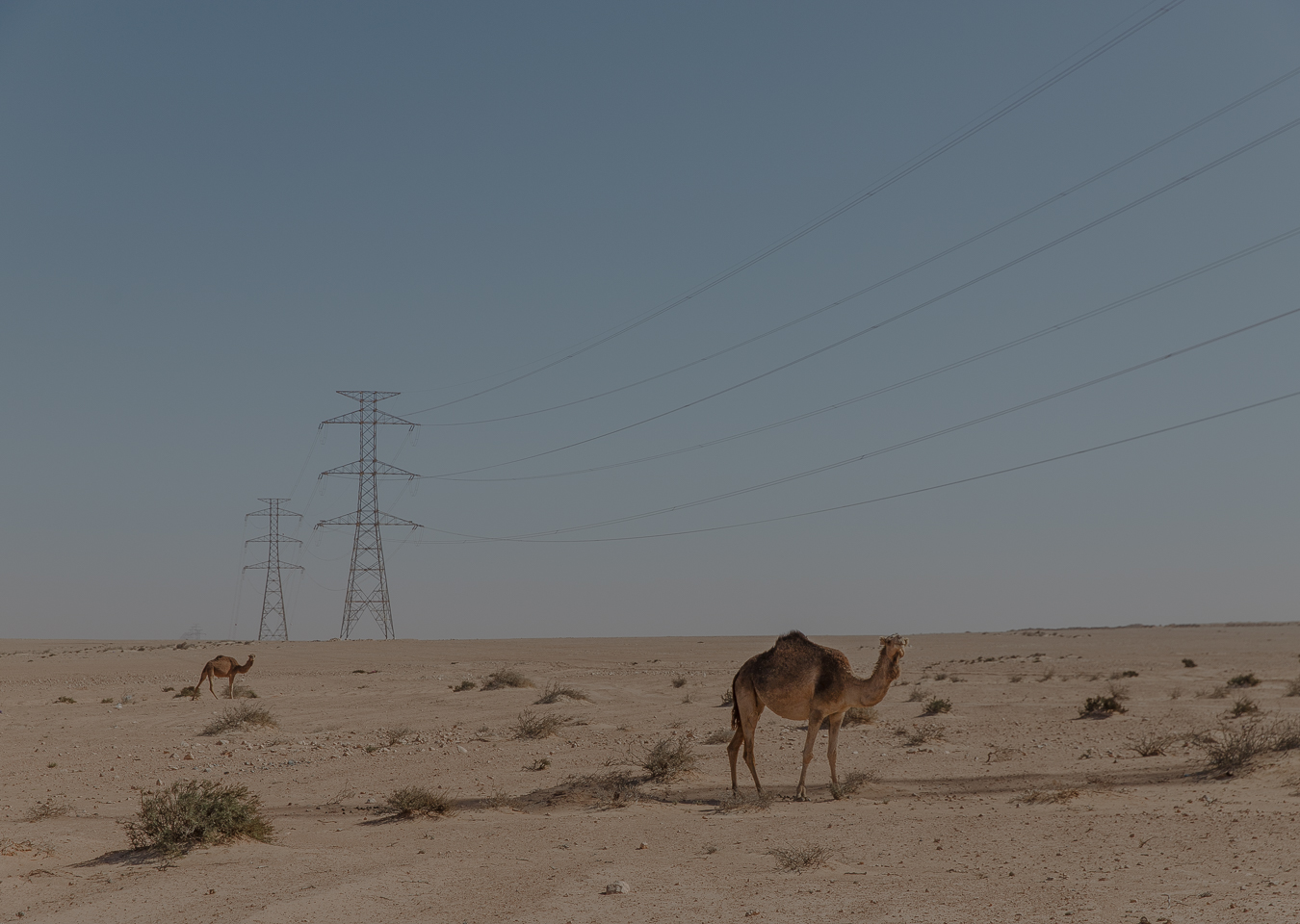
A company closely linked to Morocco’s royal business network has entered a new project in occupied Western Sahara, partnering with a Chinese state-owned electricity giant on high-voltage infrastructure in Boujdour.
Don't let resource exploitation decide Western Sahara's future
Western Sahara Resource Watch calls on the UN to address the accelerating exploitation of the territory’s natural resources - and prevent it from becoming an even greater obstacle to self-determination.