The world’s largest certification scheme for “safe and sustainable animal feed” does not check whether its certified fish feed companies source from illegal fisheries in occupied Western Sahara, where catches violate the Saharawi people’s right to self-determination.
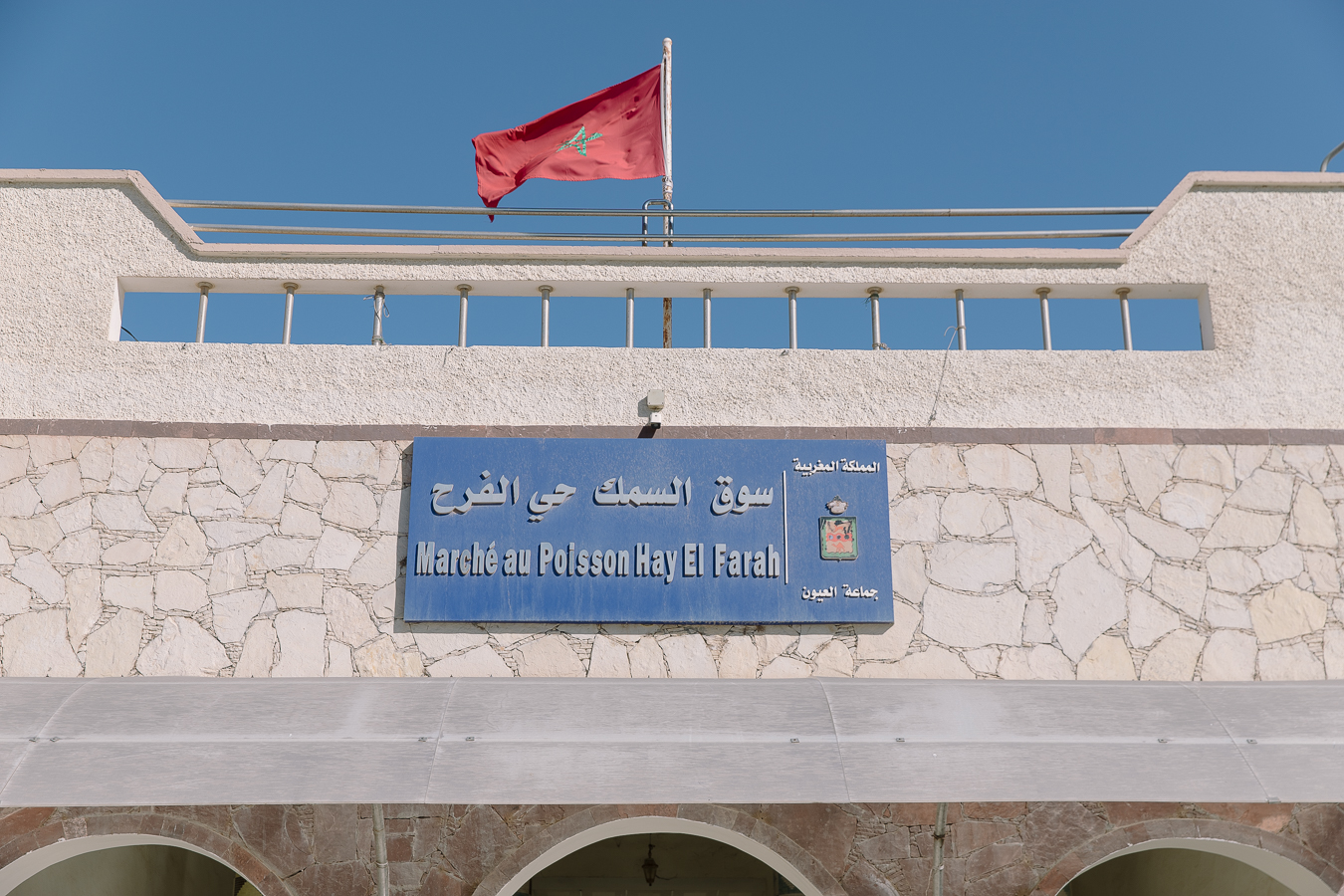
Photo: Morocco's fish market in El Aaiún, occupied Western Sahara.
Can fish caught by illegal Moroccan fisheries in the occupied waters of Western Sahara end up in GMP+ certified fish feed used by European aquaculture companies to feed their farmed salmon? Absolutely.
Can GMP+ certified companies misrepresent the country in which they operate or which national laws govern their safety requirements? Yes, entirely.
Morocco has since the beginning of the millennium built a gigantic industry in occupied Western Sahara for transforming small pelagic fish into fish oil and fish meal for the international market. The produce is exported to Europe and Turkey, where it is used for mostly animal food in aquaculture. The multi-million Euro/year industry that takes place in direct contradiction of the principles outlined by a series of ten CJEU rulings from 2015 to 2024. The industry is led by a dozen factories in the port of El Aaiún, the capital city of Western Sahara.
The Saharawis, who to a large extent live as refugees in camps abroad following Morocco’s invasion of the territory, have not given consent to the Moroccan fisheries practices, processing industry and exports. While shiploads of “certified” fish oil and fish meal are exported by Moroccan interests in the territory, UN organisations in the refugee camps called in June 2025 on the international community to increase the humanitarian aid due to severe malnutrition.
EU court finds fish sector in violation of self-determination
Because the Saharawi people – the real owners of the fish products that are exported from the territory – have not given their consent to Morocco’s trade with Western Sahara’s products, the highest court in the EU has ruled the EU-Moroccan trade with such products to be contrary to international law. Both before and after the 2024 rulings found the gigantic trade agreement to violate the rights of the Saharawi people, the certification scheme GMP+ certified the involved companies as “sustainable”.
Since Western Sahara is “separate and distinct” from Morocco, and the people of Western Sahara have not given its consent to Morocco’s agreements with the EU, the CJEU has invalidated all EU’s agreements with Morocco applicable to Western Sahara.
The EU court ruled that:
- Western Sahara waters are not part of Morocco’s, and that the EU fleet therefore cannot fish there.
- Fisheries products from Western Sahara cannot be part of EU-Morocco’s free trade agreements, as the Saharawi people have not consented.
- Products that are sold in Europe cannot be labelled as from Morocco, but must be labelled as from Western Sahara.
Narrow sustainability focus
But the assessments behind the GMP+ certificates of sustainability do not take any of this into account. The legality of the Moroccan fisheries in Western Sahara waters, and the Saharawi people’s right to decide the management of its own resources, are simply not among the criteria that are being looked at when Moroccan companies on occupied land are given GMP+ certificates of “sustainability”.
The GMP+ system, run by the Dutch-based GMP+ International B.V., is aimed to prevent hazards in the feed supply chain, ensuring that feed products are safe for animal consumption and, consequently, for human consumption through the food chain. The mission of GMP+ International is, according to its own website “to enable every company in the feed chain to take responsibility for working in a safe and sustainable way.” It offers “uniform international standards to produce safe feed and a growing set of international standards for sustainable feed”.
When asked whether GMP+ International has investigated whether issuing of certifications in Western Sahara are compatible with the Saharawi people's right to self-determination, or how sourcing from occupied territories aligns with GMP+ International’s stated mission of “sustainability,” the organization explained that it considers such matters to fall outside its scope.
“The activities of GMP+ International focus on feed safety and specific sustainability topics. Legality of fishery practices or fishery permits do not fall under the scope of GMP+”, it wrote in a mail to WSRW.
As such, Moroccan companies operating in the occupied territory are routinely allowed to obtain certificates of sustainability. These are then – all of them – erroneously filed in GMP+ registry as companies located in “Morocco”.
One year after WSRW alerted GMP+ International to the seriously incorrect country information in its directory of certified companies, the false entries remain unchanged. In fact, since WSRW first wrote to GMP+ International in late 2024, two additional facilities have been certified in occupied Western Sahara, both with false country designations.
These are the GMP+ certified entities in Western Sahara – nearly the entirety of the Moroccan multi-million-euro industry:
The certification database of GMP+ included a dozen registrations, when WSRW first contacted GMP+ in November 2024:
- GMP058119. Alpha Atlantique de Sahara Marocaine, Laayoune, Morocco (Standard: GMP+ Feed Safety Assurance Module 2020. Scope: Production of feed materials)
- GMP011127. Atlantic Tank Terminal, Laayoune, Morocco (Standard: GMP+ Feed Safety Assurance Module 2020. Scope: Storage and Transshipment of feed, Trade in feed)
- GMP031036. Copelit, Laayoune, Morocco (Standard: GMP+ Feed Safety Assurance Module 2020. Scope: Production of feed materials)
- GMP059994. Elam Sahara, Dakhla, Morocco (Standard: GMP+ Feed Safety Assurance Module 2020. Scope: Laboratory testing)
- GMP008469. KB Fish, Laayoune, Morocco (Standard: GMP+ B2 Production of Feed Ingredients. Scope: Production of feed materials)
- GMP007430. Laayoune Proteines, Laayoune, Morocco (Standard: GMP+ B2 Production of Feed Ingredients. Scope: Production of feed materials)
- GMP014473. Overseas Proteines SARL, Laayoune, Morocco (Standard: GMP+ Feed Safety Assurance Module 2020. Scope: Trade in feed)
- GMP050256. Protein and oil industry, Dakhla, Morocco (Standard: GMP+ Feed Safety Assurance Module 2020. Scope:Trade in feed)
- GMP013819. Société de transport, fourniture et consulting Industriel (STFCI), Laayoune, Morocco (Standard: GMP+ Feed Safety Assurance Module 2020. Scope: Road transport of feed)
- GMP057658. SOMATRAPS, Laayoune Port, Morocco (Standard: GMP+ B2 Production of Feed Ingredients. Scope: Production of feed materials)
- GMP009318. TISCOP trading SARL, Laayoune, Morocco (Standard: GMP+ Feed Safety Assurance Module 2020. Scope: Trade in feed)
After WSRW wrote GMP+ International on 29 November 2024, four new erroneous filings were made, and one was removed:
- Added: GMP061776. OUED EDDAHAB PRO, "Dakhla, Morocco" (Standard: GMP+ Feed Safety Assurance Module 2020. Scope: Production of feed materials). Certified since January 2025.
- Added: GMP061636. PELAGIC PRO II. "Dakhla, Morocco". (Standard: Certificates - GMP+ Feed Safety Assurance Module 2020. Scope: Production of feed materials). Certified since December 2024.
- Added: GMP061900. EXPERT LABORATOIRE ANALYTIC MAROC (ELAM). "Laayoune, Morocco". (Standard: Certificates - GMP+ Feed Safety Assurance Module 2020. Scope: Laboratory testing). Certified since January 2025.
- Added: GMP050506. Delta Ocean, “Laayoune, Morocco” (GMP+ Feed Safety Assurance Module 2020. Scope: Production of feed materials). Certified since July 2025.
- Removed: GMP050257. Sepomer Sahara Sarl, Laayoune Port, Morocco (Standard: GMP+ B2 Production of Feed Ingredients. Scope: Production of feed materials)
These are in accordance with the one or more of the following 5 “scopes”:
- Production of feed materials
- Storage and Transshipment of feed
- Laboratory testing
- Road transport of feed
- Trade in feed
WSRW reported yesterday that the Dutch certification scheme ASC has decided to stop issuing certifications in the occupied territory.
One year has now passed since the EU Court of Justice on Western Sahara ruled on the trade and labelling. Still, Moroccan companies engaged in sourcing fish from illegal fisheries on Moroccan licences and falsely informing about their origin still carry the GMP+ certificate.
Paradoxically, GMP+ International on 22 April 2025 published a statement on Western Sahara on its website.
“The CJEU ruling is related to the EU-Morocco trade agreements regarding fisheries and agricultural products, and the labelling of products from Western Sahara. While GMP+ International does not take a position on legal or political matters outside the scope of feed certification, we want to ensure that you are aware of this development. If you are operating in or working with companies in this region, this ruling may be relevant when assessing certification applications and company registrations. For more information, we encourage you to consult official sources or legal advisors”, the organisation wrote.
Less than two months after the publication of the statement, on 17 July 2025, GMP+ accepted yet another certificate in the territory, incorrectly filed in its registry as located in “Morocco”, in contradiction of the court rulings.
Passing on the responsibility
GMP+ International informs that the certifications are based on the information that the establishments themselves are providing, and that the responsibility of the certifying process is of the certifying bodies. “Registration of a company address is done by the Certification Bodies, based on the information they receive from the (certified) companies”, it noted. “Certification Bodies have the responsibility to assess if companies comply with the requirements as set out in our GMP+ FC scheme documents”, the company wrote.
WSRW has found two separate lists (here and here) on the GMP+ website of such certifying bodies that are allowed to check if the producing companies operate in line with the standard.
WSRW has written to a few of these on various aspects of certifications over the last year. The only one that responded, TÜV Rheinland, wrote that “In compiling certificates, we (…) must use company data as provided in the respective local commercial register in which our client is listed. (…). We would like to point out that TÜV Rheinland refrains, as a matter of policy, from taking positions or making judgements on questions of international law”.
As such, it chooses blindly to refer to the territory as filed by the Moroccan company on occupied territory, instead of relying on the rulings of the highest court in Europe.
Another one of the certifying bodies that GMP+ International allows to undertake such checks - Bureau Veritas - has strong political opinions on the conflict that are contrary to the position of international courts. The fact that a certification body that is to carry out legal compliance checks has political positions that are contrary to the ones of international courts is not something GMP+ International considers outside the scope of its oversight. “The political position of Certification Bodies is not part of our scope”, GMP+ International commented.
GMP+ International stated that it is not in a position to share further details regarding specific certificates. “All information that can be publicly shared is available on our website. On the basis of our agreements with Certification Bodies and certified companies”, it noted. It underlines that certification “is the responsibility of and carried out by Certification Bodies” and that these bodies are responsible for the correct registration of the certified companies.
“GMP+ International has not discussed CJEU decisions of October 4th with Certification Bodies or certified companies. (...) We will bring the situation in the Western Sahara to the attention of our Certification Bodies, including the recent CJEU’s rulings”, it wrote to WSRW on 13 December 2024.
Erroneous filings ignoring the conclusions of the court, presenting Western Sahara locations as if they are in Morocco, were made in the GMP+ registry both shortly before and after that promise: on 9 December 2024 and 24 January 2025.
Offers food fraud advice
All that a Moroccan company in occupied Western Sahara needs to do in order to be filed in the wrong country in GMP+’s database, is to provide the certifying body with the wrong country information.
Neither the certifying body nor GMP+ International seem then to follow up the errors further. Anyone checking the GMP+ International’s registry will find this false geographical information confirmed. It is as if the 4 October 2024 rulings, including on accurate country-of-origin labeling, and the “separate and distinct” status of Morocco and Western Sahara simply do not exist.
The Moroccan companies can then, through their own communication channels, not only misrepresent the country they are based in, but do so alongside the logo of the leading label for “safe and sustainable animal feed” in the world.
To questions as to whether GMP+ agrees with the international courts and the United Nations that Western Sahara is not part of Morocco, GMP+ International responded that “GMP+ International is a private company with limited liability under Dutch law. We comply with the regulations that apply to our business operations.”
The misrepresentation of a product’s country of origin constitutes acts of food fraud. GMP+ itself refers to “False declarations of geographic (…) origin” as examples of food fraud.
GMP+ International offers a “Possible fraud control plan” to its certified companies, that recommends them to cross check information from suppliers/producers with “the data present in the GMP+ certified company database”. Considering that the country of origin information in the GMP+ company database is erroneous, distributors in Europe may unknowingly take part marketing products with incorrect origin information, creating potential exposure to mislabeling risks under EU law, in the case they follow the GMP+ Food Fraud control plan by using the erroneous GMP+ country of origin information as point of departure.
Following the ruling of the CJEU on products from Western Sahara, companies on the EU market are now obliged to label products from Western Sahara as “Western Sahara”, not from “Morocco”.
In the case of the 15 Moroccan firms that are incorrectly listed in the GMP+ registry, the issue is not the product itself, but the exporters’ false claim to be located in a country other than where they actually operate.
So far, the issue of incorrect country designation in the GMP+ database appears to be limited to Western Sahara. WSRW has not observed GMP+ International applying the same approach in other occupied territories, by listing companies operating on illegally occupied land as being located within the borders of the occupying state.
Lack of transparency
None of the 15 Moroccan GMP+ certified companies in the occupied territory - with the single exception of the French mother company of Atlantic Tank Terminal, Olvea - have replied to letters from WSRW. Olvea did not respond to questions relating to its GMP+ certificate, and did not share with WSRW a copy of the GMP+ certificate.
In the "F0.0 Introduction on the GMP+ FC scheme 2020", it is noted that “The GMP+ Feed Certification scheme is based on the following six key principles which are applicable to any of the members of the GMP+ Community: [...] e) Encouraging transparency and involvement with multiple stakeholders”.
GMP+ International did not respond to what sort of sanctions await certified companies that remain non-communicative. “It is a company’s responsibility to engage with and reply to queries of third parties”, it stated.
GMP+ International did not share with WSRW information regarding which Certifying Bodies have certified the 15 Moroccan establishments in Western Sahara and the fishmeal importing company KMP in Germany. As such, it is impossible for WSRW to question these certifying bodies as to why the gravely erroneous registrations were filed to the GMP+ registry. GMP+ International did not answer as to whether the certifying bodies had travelled into the occupied territory as part of the certification procedure.
GMP+ International did not explain how WSRW could obtain answers from the certified German company KMP, the main importer of fishmeal into Europe from occupied Western Sahara. Since 2018, WSRW has attempted to contact KMP on seven occasions - without success, lastly in July 2025.
Which legislation?
In the scheme’s paragraph 4.1., "F0.1 Rights and Obligations" paragraph 4.1. it is stated that "A company must be a legal entity and must have a legal business registration at the competent authority in the country in which it is based." The GMP+ Feed Safety Assurance Module 2020, R1.0 - Feed Safety Management Systems Requirements, paragraph 4.1, reads that the certified company “must comply with the applicable feed legislation. This relates to feed legislation: a. in the country in which the certified company is located; b. in the country where the feed is marketed.[...] In all of the above cases, it is the most strict requirement which is applicable for GMP+ certified companies.”
From an EU law perspective, which establishes that Western Sahara is not part of Morocco, WSRW can only regard Moroccan feed legislation and safety controls in Western Sahara as irrelevant to an EU-based initiative like GMP+ International. The organisation did not clarify which national legislation it believes applies to Western Sahara, nor did it respond to questions about which country it believes the 14 Moroccan establishments in El Aaiún and Dakhla to be located in.
It underlined that it is “a company’s responsibility to comply with relevant (feed) legislation”.
GMP+ certified companies must “have a legal business registration at the competent authority in the country in which it is based”. The certified companies do not have that – unless one chose to ignore the rulings of the international courts. GMP+ International does not respond how a Moroccan business registry could be relevant in view of the EU case law. Neither of the 15 establishments have seemingly registered with the Western Sahara liberation movement, which CJEU considers to legally represent the Saharawi people.
The same apparent failure to adhere to its own legal expectations appears under the Standard’s §8.5. Hazard Control, 8.5.1.1. It states that "The GMP+ certified company must keep documented information up-to-date about all feed materials, feed additives and processing aids as far as needed for identifying hazards and do a risk assessment (see §8.5.2.2). The following information must be documented: [...] d. place of origin (provenance); [...] k. legal requirements (see §4.1)..." GMP+ International did not clarify what country of origin that companies in Western Sahara are supposed to file.
In addition to certifying companies operating directly in the occupied territory, GMP+ International also allows certification of companies registered in Morocco proper that source raw materials from fish stocks in Western Sahara. GMP+ International has not explained how these Morocco-based companies ensure legal compliance within their supply chains.
Some of the companies that brand themselves as GMP+ certified are clearly selling products from Western Sahara as if they were from Morocco. GMP+ International did not respond to what checks are taken, if any, to ascertain that the certified distributors are not including in its supply chain products that originate from Western Sahara, or that are incorrectly labelled, in violation of the EU case law.
According to GMP+ International, the certification will demonstrate that the companies “meet all requirements and conditions for the assurance of feed safety. By applying safe practices across the entire feed chain, companies contribute to safer feed, worldwide”. It states that the companies will thereby “meet market requirements for working more sustainably and responsibly. By using a responsible production process, companies contribute to more sustainable feed, worldwide.”
Its feed certification (GMP+ FC) scheme consists of two modules: GMP+ Feed Safety Assurance (GMP+ FSA), and GMP+ Feed Responsibility Assurance (GMP+ FRA). Companies can be certified for one or both modules.
Since you're here....
WSRW’s work is being read and used more than ever. We work totally independently and to a large extent voluntarily. Our work takes time, dedication and diligence. But we do it because we believe it matters – and we hope you do too. We look for more monthly donors to support our work. If you'd like to contribute to our work – 3€, 5€, 8€ monthly… what you can spare – the future of WSRW would be much more secure. You can set up a monthly donation to WSRW quickly here.

One of the richest coastlines in the world
The fish stocks of occupied Western Sahara have not only attracted the interest of the Moroccan fleet: other foreign interests are also fishing in the occupied waters through arrangements with Moroccan counterparts. Along the Western Saharan coastline, a processing industry has emerged.
Confirmed: fishmeal from Western Sahara exported to Bremen
The Bremen port authorities have now confirmed WSRW’s hypothesis that a shipment of fishmeal from Western Sahara arrived in Bremen (Germany) two weeks ago – though they erroneously locate the town of origin, El Aaiun, in “Morocco”.
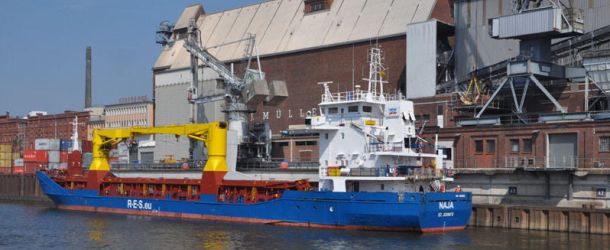
Has another cargo of fishmeal from Western Sahara arrived in Germany?
On Tuesday, a cargo vessel arrived at the port of Bremen with a new probable cargo of conflict meal.
Bremen sheds light on massive controversial fishmeal import
The imports of fishmeal into Germany from occupied Western Sahara is a lot larger than what has been known to the public so far, according to fresh data from the Bremen government.